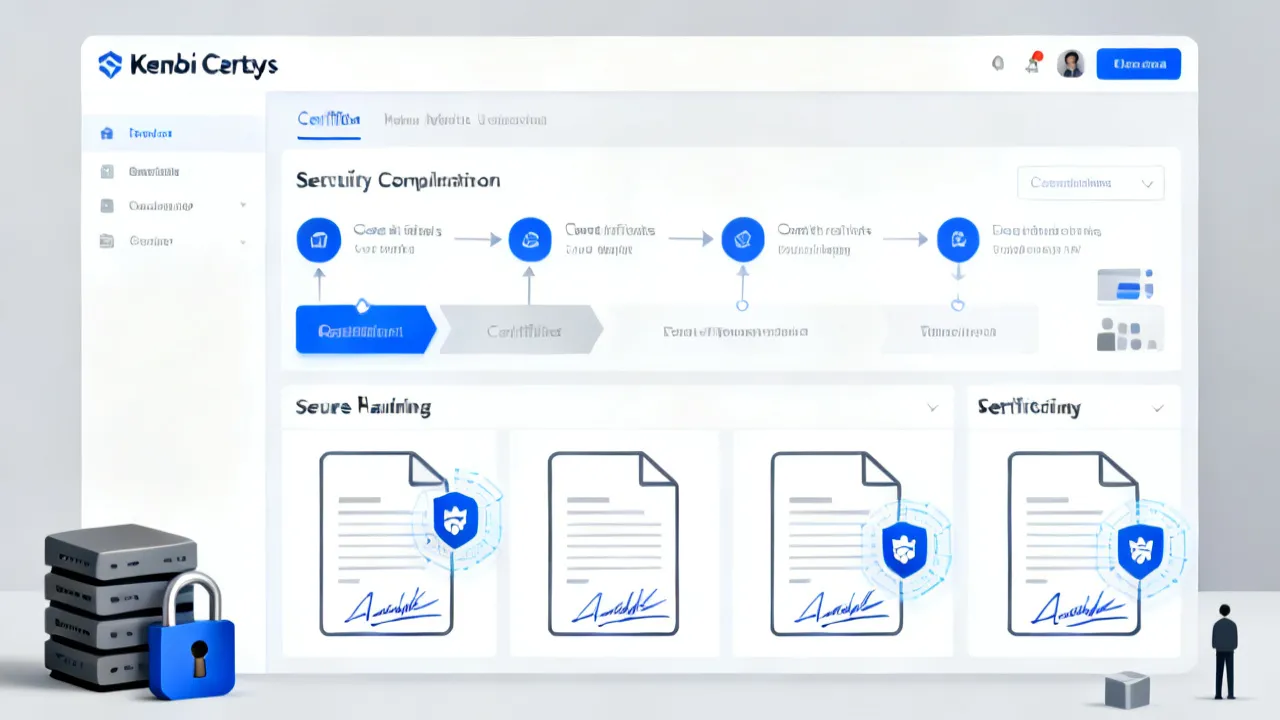
Kenobi Certsys Guide for Compliance and Suppliers
This guide explains how Kenobi Certsys supports compliance workflows and supplier readiness, focusing on practical requirements rather than hype. Background details clarify what “Kenobi Certsys” typically means in industry contexts, how certification and document control affect audits, and why clear supplier procedures reduce delays and corrective actions.

1) Executive overview: why Kenobi Certsys matters for audit-ready suppliers
Kenobi Certsys is commonly used as a shorthand for an organizational approach to certification support and system-based compliance—particularly where suppliers must demonstrate controlled processes, traceable documentation, and consistent evidence for audits. For procurement, quality, and compliance teams, the core value is straightforward: it helps you structure how requirements are collected, how evidence is stored, and how readiness is validated before an audit, customer review, or internal quality assessment.
From an industry perspective, the very important point is not “having documents,” but proving that the documents reflect controlled work. That is where a certification-oriented system approach—often referred to through labels like Kenobi Certsys—becomes operationally useful: it reduces ambiguity, strengthens traceability, and supports repeatable decisions when multiple suppliers and product families are involved.
If you are evaluating suppliers, building onboarding packs, or harmonizing evidence across sites, the practical question is: Can the supplier reliably produce consistent audit evidence within set timelines? A Kenobi Certsys-style workflow is designed to answer that question with structured steps and clear conditions.
In practical procurement terms, this matters because evidence discipline is not a “quality department activity” that happens only at audit time. It affects how suppliers interpret your requirements, how they document changes, how they train people to execute procedures, and how quickly they respond when questions arise. When a supplier’s evidence system is stable, audit preparation becomes a planned activity rather than a crisis response, and audit outcomes tend to become more predictable across product lines and business units.
Moreover, an audit-ready supplier environment often reduces the hidden costs of compliance: rework of submissions, additional sampling requests, corrective action escalations, and internal management time spent explaining what was meant by an unclear requirement clause. Kenobi Certsys logic aims to reduce those inefficiencies by making the “chain of proof” visible: requirement → procedure → record → outcome.
Finally, Kenobi Certsys-style thinking also supports continuity. Audits come and go, people change roles, and systems evolve. A well-structured approach ensures evidence remains retrievable even after staffing changes or internal reorganizations. That continuity is critical when you manage multiple suppliers, span several sites, or require consistent demonstration of compliance for contract renewals.
2) What “Kenobi Certsys” typically refers to in compliance ecosystems
In many procurement and quality environments, phrases resembling “Kenobi Certsys” function less like a standalone product term and more like a programmatic reference: a compliance-support system or methodology used to align certification requirements, documentation control, and supplier responsibilities. In other words, it often represents:
In practice, it is a way of talking about a shared discipline among auditors, customers, suppliers, and internal teams. Even if the label differs from organization to organization, the underlying intent is consistent: establish predictable evidence creation and evidence presentation, so that compliance can be verified quickly and fairly.
Because terminology varies, some suppliers may interpret “Kenobi Certsys” as a specific template package. Others may interpret it as a set of expectations about readiness. Still others may treat it as an internal quality system framework. The key is not the name itself but the operational logic behind it: structured governance, controlled documentation, traceable evidence, and objective readiness checks.
Even when toolchains differ (e.g., share drives, QMS systems, spreadsheets, document management systems), auditors will look for the same essentials. A Kenobi Certsys-style approach makes those essentials part of a repeatable workflow.
Typically, “Kenobi Certsys” therefore includes:
- Document governance (versioning, controlled templates, approvals)
- Evidence management (what is collected, where it is stored, how it is retrieved)
- Readiness checks (whether the supplier can demonstrate compliance before the audit date)
- Traceability (linking procedures to records and records to specific requirements)
Even when different organizations use different toolchains, the underlying compliance logic stays the same: auditors and customers want to see consistent controls, repeatable processes, and a clear chain from requirement → procedure → record → outcome.
In mature environments, “Kenobi Certsys” logic is also reflected in how teams handle exceptions. Instead of ad hoc justifications, suppliers follow defined pathways for deviations, corrective actions, preventive actions (where applicable), and evidence updates. That is where maturity shows itself—when the system continues to work during change, not only during “perfect” conditions.
3) Where certification support impacts real procurement outcomes
Certification and compliance workflows directly affect lead times, supplier onboarding, and risk management. When those workflows are informal or ad hoc, common pain points appear—some subtle, some expensive:
- Last-minute evidence gathering that strains supplier teams and causes incomplete submissions.
- Inconsistent document versions (e.g., forms updated after a process change, but evidence still referencing older templates).
- Unclear ownership (who within the supplier is responsible for approving evidence and responding to corrective actions).
- Gaps in traceability where records exist, but they cannot be linked to the specific requirement being assessed.
Kenobi Certsys-oriented thinking addresses these issues by encouraging structured readiness: define what “good evidence” looks like, build repeatable steps to collect it, and apply clear conditions for acceptance.
From a procurement lens, the effects are measurable:
- Faster supplier onboarding: when expectations are clear, suppliers can prepare systematically before your onboarding timeline ends.
- Reduced contract risk: if evidence and corrective action processes are stable, you can better manage the likelihood that quality failures become expensive deviations later.
- More reliable supplier performance reviews: evidence that is comparable across cycles allows objective trending.
- Lower internal burden: quality and compliance teams spend less time answering “where is the proof?” questions and more time verifying effectiveness.
Certification support is therefore not merely administrative work. It is a risk management strategy that influences whether your organization can rely on suppliers to deliver products and services that meet defined requirements.
A common misconception is that compliance is primarily about documentation volume. In reality, what matters is whether the evidence corresponds to the relevant period and shows that the process is executed consistently. A Kenobi Certsys-style workflow helps ensure evidence is meaningful and audit-ready, improving decision quality for procurement and compliance teams.
4) Supplier readiness: what quality teams should verify
In an expert quality-management lens, supplier readiness is top evaluated across three layers. Each layer should be verifiable, not merely asserted.
Many organizations focus on only one layer—usually the existence of documents. But auditors and experienced internal assessors typically look beyond documents. They test whether the supplier’s system behaves correctly when evaluated. The three-layer approach ensures you evaluate evidence governance, evidence quality, and evidence effectiveness through corrective action maturity.
4.1 Layer one: governance and process control
Ask whether the supplier can show controlled processes, such as:
- Documented procedures for relevant activities
- Approval workflows (who approves, how changes are validated)
- Training records linked to procedure ownership
This matters because evidence that lacks governance is often fragile under audit scrutiny. If a supplier cannot demonstrate how the process is controlled, auditors may conclude the organization is not managing risk adequately—even if records exist.
To evaluate governance effectively, you should also consider how the supplier handles:
- Changes: Are process changes reviewed, approved, and communicated? Are the correct documents updated? Are records created with the correct template after the change date?
- Access: Are controlled documents protected from unauthorized alteration? Are obsolete versions prevented from being used?
- Competence: Are people trained not only on “what the procedure says,” but on “what they must do” to achieve compliant outcomes?
Governance is where the “system discipline” starts. If governance is weak, evidence is likely to be inconsistent and hard to defend.
4.2 Layer two: evidence quality and traceability
Then assess the evidence itself:
- Are records complete for the relevant time window?
- Do records map to the specific requirements being reviewed?
- Are measurement and calibration practices described and traceable?
In supply chains, “traceability” is not just a buzzword. It is the ability to follow a documented thread from requirements to outcomes. A Kenobi Certsys-style workflow typically emphasizes this link so that audits move faster and fewer corrective actions are triggered.
Traceability is often tested through a “traceability test” during assessment. For example, an assessor might select one requirement clause and ask where the corresponding procedure exists, which records demonstrate adherence, and whether those records reflect the right versions and the right time coverage.
Evidence quality also includes:
- Completeness: Are all required data fields filled, with no unexplained blanks?
- Timeliness: Are records created when the activity occurs, not later?
- Legibility: Are documents readable and unambiguous (especially for scanned forms)?
- Consistency: Do records show repeatable patterns aligned with the stated procedure?
In addition, auditors often look for “evidence integrity.” If records appear selectively compiled or if they contradict procedure expectations, credibility suffers and corrective actions may increase.
4.3 Layer three: continuous improvement and corrective actions
Finally, check how the supplier handles deviations and improvements:
- Are nonconformities logged, investigated, and closed with evidence?
- Are preventive actions documented and reviewed?
- Do improvements reflect analysis of root causes rather than quick fixes?
Auditors tend to ask not only “what happened,” but “what changed afterward, and how do you ensure it does not recur?” This is where certification-oriented systems help suppliers demonstrate maturity.
In a Kenobi Certsys-style mindset, corrective action is not just a record that says “CAPA closed.” Instead, it should include evidence that:
- The cause analysis is credible and linked to the problem statement
- The action plan includes appropriate measures
- Effectiveness is verified after implementation
- Lessons learned are integrated into future controls (training updates, procedure changes, monitoring adjustments)
Another maturity indicator is trend management: does the supplier look at recurring issues across audits, customer feedback, internal nonconformities, and process performance data? When this is integrated, compliance becomes more resilient.
By evaluating these three layers together, quality teams can form a defensible view of supplier readiness. That view is essential for deciding whether a supplier can be onboarded, approved for new work, or relied upon for critical product lines.
5) Pricing and commercial context: how cost typically aligns with compliance scope
You mentioned price information and supplier details; however, no specific values were provided. In compliance and certification-support services, pricing usually varies with the following practical factors:
- Scope of requirements (number of standards, product lines, sites)
- Complexity of evidence (manual vs. digital records, volume of documents)
- Level of onboarding support (templates, training, readiness reviews)
- Timeline urgency (how soon evidence must be prepared for an upcoming audit)
- Number of supplier entities (single facility vs. multi-site supplier networks)
From a procurement standpoint, you should request a scope-based quotation rather than a vague “per supplier” fee. A well-structured supplier quote should explain what deliverables are included (e.g., readiness checklist, evidence mapping, document control guidance), and what responsibilities remain with the supplier.
Additionally, pricing often reflects the “work to be done” model. Some suppliers already have controlled documents and stable evidence systems, requiring only mapping and gap validation. Others have inconsistent versions, missing records, weak governance, or unclear corrective action closure. In those cases, the support service may include governance strengthening activities and evidence remediation planning.
When evaluating quotes, ask how the vendor measures progress. For example, deliverables might include:
- A completed requirement-to-evidence matrix
- Document control rule set and template package
- Readiness assessment report with prioritized gaps
- Remediation plan including owners and closure criteria
- Audit response pack structure and evidence index template
Condition to remember: if a quote does not clarify deliverables or acceptance criteria, it can create misalignment during audits. That misalignment often costs more than the initial budget difference.
Also clarify what “success” means for the service. Is the goal to pass a specific audit? Is it to achieve internal readiness acceptance? Are there defined quality checks for the evidence mapping output? If success criteria are not defined, you may pay for effort without achieving audit-ready status.
Finally, ensure procurement recognizes that compliance support involves both supplier work and support team work. If the vendor quote assumes the supplier will “provide missing evidence immediately” without internal work effort, timelines may slip and costs may increase.
6) Supplier onboarding: top practice workflow built around Kenobi Certsys logic
Below is a practical, industry-style approach you can adapt. It assumes you want repeatable results across suppliers—especially when multiple teams contribute to evidence creation and review.
Use this workflow as a baseline. Then tailor it to your internal risk appetite and audit cadence. For highly regulated sectors, the matrix might need to cover statutory records and specific calibration traceability requirements. For less regulated but customer-driven sectors, the matrix might focus on customer-specific quality clauses, process controls, and service execution evidence.
To keep onboarding efficient, avoid treating evidence collection as a one-time event. Instead, design the supplier system to produce evidence continuously where possible, then compile it for audit readiness.
- Define the compliance requirements (standard clauses, customer requirements, regulatory obligations relevant to the product or service).
- Create a requirement-to-evidence map that lists the expected document types and record types for each requirement.
- Set acceptance criteria (what “complete” evidence looks like, common rejection reasons, required version numbers, required time coverage).
- Assign ownership for both evidence preparation and approvals inside the supplier organization.
- Run a readiness review before the audit window (internal check, gap analysis, and remediation plan).
- Document corrective actions with root-cause analysis and closure evidence where required.
- Maintain version-controlled archives so that evidence is retrievable quickly when auditors ask for clarifications.
This is essentially how Kenobi Certsys-style certification support functions in practice: it turns compliance from an “end-of-cycle scramble” into a controlled workflow with measurable completion.
To make this workflow operational, it helps to define roles and interfaces. For example:
- Supplier Evidence Coordinator: ensures the matrix is followed and evidence is compiled.
- Process Owners: provide controlled procedures and show records generated by their processes.
- Document Controller / QMS Officer: validates document control status and ensures version control compliance.
- Internal Auditor / Quality Lead: conducts readiness review and verifies corrective action closure criteria.
When these roles are explicit, suppliers are less likely to send incomplete evidence packages and more likely to respond quickly to audit questions.
7) Comparison table: methods, outputs, and conditions for readiness
Use the table below to compare how a Kenobi Certsys-oriented approach typically differs from more ad hoc supplier preparation. (No links are included.)
| Topic | Kenobi Certsys-style approach | Ad hoc / informal preparation | Conditions / requirements for acceptance |
|---|---|---|---|
| Evidence organization | Structured mapping of requirement → procedure → record | Folders created late, often without clear traceability | Evidence must be version-controlled and traceable to the requirement under review |
| Document control | Defined templates, approval workflows, change history expectations | Multiple versions circulate via email or shared drives | Only approved versions may be submitted; reviewers must be identifiable |
| Readiness timing | Readiness review scheduled before audit window | Evidence assembled during the audit period | Supplier must complete gaps remediation by a defined cutoff date |
| Corrective action handling | Root-cause analysis with closure evidence and review | Corrective actions recorded without verification | Closure must include objective confirmation that risk is addressed |
| Responsibility clarity | Named owners for each evidence category and response duties | Unclear ownership slows responses to audit questions | Supplier must provide a single point of contact plus role-based backups |
| Evidence quality assurance | Structured sampling and validation aligned to matrix requirements | Assumes evidence is correct once documents are provided | Evidence is checked for completeness, time coverage, and correct version selection |
| Audit response readiness | Audit response pack with index and requirement-group alignment | Responses improvised with limited index support | Supplier can locate and present evidence rapidly for any auditor question |
8) Source and conditions: grounding the approach in recognized quality principles
Because “Kenobi Certsys” can be used as a program label rather than a universally standardized term, the very reliable way to validate the approach is by anchoring it to established quality-management expectations. Organizations commonly align supplier evidence discipline with widely used management-system frameworks and audit top practices.
Sources (for background principles):
- ISO 9001 — Quality management systems; emphasizes documented information control, competence, internal audit, and corrective action processes.
- ISO 19011 — Guidelines for auditing management systems; emphasizes audit evidence, impartiality, and systematic approach.
Conditions/requirements to apply the logic consistently:
- Requirements must be translated into measurable evidence expectations (not vague “provide documents”).
- Acceptance criteria must cover both documentation quality and record traceability.
- Evidence must be collected within defined time coverage windows relevant to the audit scope.
To apply these principles correctly, consider the “audit evidence rule.” Evidence is not the same as a claim. Evidence must be verifiable. That means your process should specify:
- What evidence counts (types of records, required fields, required approvals)
- What evidence does not count (uncontrolled drafts, screenshots, incomplete extracts)
- How evidence is authenticated (version checks, approval IDs, traceability)
This alignment helps suppliers understand why certain requests come up repeatedly during audits. It also reduces rework, because the supplier knows which evidence items are likely to be challenged.
9) Step-by-step guide for implementing a Kenobi Certsys-like supplier readiness process
Below is a step-by-step guide you can use even if your organization uses different software or documentation tools. The key is the workflow discipline.
Even though this section is written as sequential steps, many organizations run it as an iterative cycle. For example, you might build the matrix, run a preliminary readiness review, and then adjust the matrix based on how the supplier actually performs the process. The key is to maintain control and documentation integrity so that the iteration does not become uncontrolled.
Step 1: Establish scope and audit triggers
Determine what “scope” means in your case—product type, service category, sites, customer requirements, and any applicable regulatory obligations. Then define audit triggers such as:
- Scheduled customer audits
- Internal audits
- Supplier onboarding milestones
- Change control events (process changes, facility changes, new production lines)
Also consider additional triggers that often catch suppliers off guard:
- Major organizational changes (new QMS lead, restructure of departments)
- Supplier sub-tier changes (new subcontractor for calibration, testing, or specialized services)
- Technology changes (new software used for inspection data or electronic records)
Defining triggers early ensures your evidence requirements do not come as surprises when timelines become tight.
Step 2: Build the requirement-to-evidence matrix
List each requirement clause and specify evidence types and record types that typically satisfy it. Your goal is to reduce interpretation during audit time. A good matrix includes:
- Requirement ID / clause reference
- Expected documents (procedures, policies, work instructions)
- Expected records (logs, certifications, inspection reports)
- Evidence frequency (how often evidence should be generated)
- Retention window expectations
To make the matrix practical, you should add “how to show compliance” hints. For example:
- If a requirement relates to training, specify what training evidence should include (training record fields, competence validation, training effectiveness approach).
- If a requirement relates to measurement, specify what calibration evidence looks like (calibration certificates, traceability statements, calibration status checks).
- If a requirement relates to document control, specify what evidence shows control (approval records, change logs, distribution lists, revision status).
This reduces ambiguity and prevents suppliers from submitting irrelevant evidence.
Step 3: Define document control rules
Set clear document control expectations so the supplier does not provide “near-enough” versions. Typical rules include:
- Only approved documents can be used as audit evidence
- Version numbers and approval dates must be visible
- Changes must be traceable via change history or controlled revision mechanism
In addition, define rules for electronic evidence. For example, if the supplier uses digital templates, specify how you will verify version control:
- Document IDs
- Controlled document repository references
- Print dates or revision stamps
Also address re-issued documents after audit-related questions. If suppliers revise procedures after the audit begins, ensure evidence is handled correctly. Auditors may ask whether a revision is reflective of actual practice or simply created to satisfy evidence requests.
Step 4: Conduct a gap analysis readiness review
Perform an internal readiness review using the matrix. Capture gaps in categories such as:
- Missing evidence
- Evidence exists but does not map to requirements
- Evidence exists but is not controlled (wrong version, incomplete record)
- Evidence exists but lacks closure to corrective actions
To increase rigor, define a scoring or prioritization method. For example:
- High risk: evidence missing or nonconformities likely to be questioned during audit
- Medium risk: evidence weak but potentially improvable quickly
- Low risk: evidence exists but needs minor formatting or indexing improvements
Prioritization helps suppliers focus effort where it reduces audit risk most.
Step 5: Create a remediation plan with closure criteria
For each gap, define:
- Responsible role (owner)
- Action description
- Due date
- Closure evidence type
Closure criteria should be objective. “Fixed” is not a closure criterion; “updated procedure approved on date X, training completed, and record samples show compliance” is.
Also define how closure evidence is validated. For example, it may involve:
- Review by Document Control for version status
- Sampling by Process Owner for implementation confirmation
- Optional internal audit sampling for higher-risk areas
Closure criteria should also address whether the corrective action changed future behavior. That means effective dates and training completion dates matter.
Step 6: Prepare an audit response pack
Organize a response pack aligned to audit question patterns. Include:
- Evidence pack by requirement group
- Quick index for evidence retrieval
- Summary of recent corrective actions and their closure status
- Competence and training evidence if required by the scope
To improve response speed, consider packaging evidence at multiple granularity levels:
- Master index: requirement-by-requirement mapping
- Section packs: grouped by topic (e.g., calibration, training, document control)
- Sampling packs: pre-selected record samples for common audit questions
Pre-selection is not about hiding evidence. It’s about reducing administrative delays. Ensure sampling packs are consistent with objective criteria and not cherry-picked to misrepresent overall process behavior.
Step 7: Validate competence and implementation, not just documents
Auditors typically probe whether procedures are followed in practice. Therefore, validate implementation by:
- Sampling records
- Confirming calibration or measurement control practices
- Verifying that training aligns with roles that execute the process
Add to this by verifying “process interfaces.” For instance, a supplier might have a well-controlled procedure, but records fail at handoff points between departments. Auditors often find gaps where responsibility is shared. To prevent that, sample across the process flow and validate that handoffs and inputs/outputs are controlled.
Competence validation can also include competency tests, work performance evaluations, or documented observation results. The goal is to confirm that trained people apply the procedure effectively.
Step 8: Maintain evidence after the audit
After the audit, update your traceability records and ensure evidence remains accessible for subsequent customer reviews, trend analysis, and future audit cycles.
Maintenance means more than archiving. It includes:
- Updating the matrix if requirements change
- Incorporating corrective action outcomes into procedures and training
- Ensuring obsolete documents are retired and distribution is controlled
When evidence maintenance is integrated into normal operations, future readiness reviews become easier, and audit preparation costs reduce over time.
10) Localization guidance: aligning compliance communication with local supplier culture
No city or country was provided in the keywords, and therefore this section focuses on universally applicable localization principles. In practice, compliance readiness improves when communication style matches the supplier’s working culture. Teams often respond better when:
- The requirements are explained in practical terms (what will the auditor ask for?)
- Timelines are agreed with realistic internal review windows
- Responsibility is explicit (names/roles, not just “someone will handle it”)
If you are working with suppliers in specific regions, consider local language preferences for training materials and ensure document templates accommodate local conventions (while remaining consistent with your controlled document standards).
Localization also affects how evidence is produced. Some suppliers rely heavily on paper processes; others use digital workflows. A Kenobi Certsys-like approach should not force a supplier to adopt a new tool immediately if the evidence can be controlled using existing systems. The key requirement is that evidence remains verifiable and traceable regardless of medium.
To localize effectively without compromising compliance, define:
- Evidence acceptance formats (paper scans vs. native PDFs vs. export formats)
- Stamping or approval conventions that indicate controlled status
- Time zone considerations for timestamps in electronic records
- Translation rules for record headers or audit response narratives
Localization must be handled carefully so that translated documents remain faithful to original controlled content. If translation is needed, keep it controlled as well, including version alignment and approval status.
11) Common FAQs about Kenobi Certsys, supplier readiness, and compliance evidence
FAQ 1: What does Kenobi Certsys mean?
Kenobi Certsys is commonly used as a reference name for a structured compliance-support approach—typically focused on certification readiness, evidence management, document control, and audit-ready supplier workflows. The exact meaning can vary by organization, so align it to your internal process definitions and evidence mapping.
When using the term in supplier communication, it is helpful to include your own definition. For example, you can define Kenobi Certsys in your onboarding letter as “our evidence mapping and readiness workflow based on requirement-to-evidence traceability and controlled documentation.” That prevents confusion about whether the supplier expects specific software, templates, or consulting deliverables.
FAQ 2: Is a Kenobi Certsys-style approach only for audits?
No. While audits are a primary trigger, the same workflow improves internal quality reviews, onboarding consistency, change control, and corrective action tracking. Strong evidence discipline is useful throughout the supplier lifecycle.
Additionally, proactive readiness can reduce rework during customer changes. For example, if a customer updates requirements mid-year, a supplier with a controlled evidence system can update and demonstrate compliance with less disruption than a supplier who maintains evidence in an informal manner.
FAQ 3: Do we need to overhaul our documents to start?
Not necessarily. Many organizations start by building a requirement-to-evidence matrix and applying stricter acceptance criteria (version control, traceability, time coverage). Overhauls are considered when gaps show systemic document-control weaknesses or insufficient implementation evidence.
A practical approach is to prioritize evidence improvements by risk. For instance, you might first fix document control for high-impact processes (calibration, training, inspection), then expand improvements to other processes. This reduces cost and accelerates the path to readiness.
FAQ 4: What evidence is typically “very important” during supplier assessments?
High-impact evidence usually includes: controlled procedures relevant to the scope, records that demonstrate consistent execution, and objective corrective action closure evidence. Auditors also look for competence/training alignment when roles perform controlled tasks.
In many audits, evidence that is “very important” tends to cluster in areas where mistakes are likely to create product or service nonconformities: measurement control, manufacturing or service execution controls, and corrective action effectiveness. However, the exact high-impact evidence depends on your requirements and risk assessment.
FAQ 5: How should we handle suppliers who provide evidence late?
Use conditions/requirements up front: define a readiness review date, a remediation cutoff date, and acceptable evidence formats. Also clarify escalation paths and identify who can approve the submission. Late delivery often signals governance or ownership gaps.
To reduce repeat lateness, implement a structured communication pattern. For example:
- Week 1: supplier acknowledges matrix and confirms evidence owners
- Week 2: supplier submits initial evidence pack for review
- Week 3: remediation and closure updates submitted
- Pre-audit: final readiness pack submission and index verification
These checkpoints reduce “everything on the due date” behavior.
FAQ 6: Can we rely on a supplier’s statement that they are compliant?
Statements help, but they are not audit evidence. Compliance decisions typically require objective documentation and record samples mapped to requirements, consistent with audit principles described in widely recognized auditing guidance.
For high-stakes requirements, you should require objective proof. For lower-risk areas, you may accept partial documentation alongside a commitment to evidence completion at defined milestones—provided you define acceptance criteria clearly.
FAQ 7: Where do ISO 9001 and ISO 19011 fit into this?
They provide a foundation for quality-management and auditing expectations, such as controlled documented information, corrective actions, and how audit evidence should be handled. You can align your Kenobi Certsys-style workflow to these principles even if your internal terminology differs.
ISO-based alignment also improves consistency across internal audit teams. When internal standards map to recognized frameworks, you reduce the chance of subjective evidence acceptance criteria and improve audit fairness across suppliers.
12) Expert perspective: how to evaluate suppliers beyond checklists
As an industry expert would frame it, supplier compliance readiness is a matter of system behavior, not only document status. A supplier may appear prepared if a folder contains many files, yet still fail an assessment if evidence cannot be traced or if records contradict procedures.
To evaluate suppliers more robustly, use the following expert checks:
- Traceability test: Can an assessor locate evidence quickly for a specific requirement and confirm it is the correct version?
- Implementation test: Do records show consistent practice over the relevant time window?
- Correction test: Are nonconformities handled with root cause analysis and closed with verification evidence?
- Competence test: Are trained roles aligned with the tasks that drive compliance outcomes?
This is the practical “why” behind a Kenobi Certsys-style approach: it makes supplier compliance measurable and repeatable.
Beyond those checks, experienced assessors often look at evidence “coherence.” Coherence refers to whether different evidence sets support the same story. For example, training records should align with procedure approval dates; calibration records should align with equipment use periods; corrective actions should align with the nature of detected nonconformities. When evidence sets contradict each other, it indicates system instability and increases audit risk.
Experts also assess the supplier’s ability to handle unexpected questions. A supplier may prepare evidence packs for known requirements but fail when auditors ask for evidence outside the expected pack. A readiness system should therefore encourage comprehensive traceability so that evidence can be produced even for unplanned queries.
Finally, experts look for evidence of ownership and accountability: who takes responsibility when gaps are found, how quickly remediation begins, and whether the supplier’s management reviews compliance evidence and trends.
13) Next steps: turning Kenobi Certsys logic into internal policy
To operationalize this guide, consider implementing an internal standard that requires:
- A requirement-to-evidence matrix for every supplier onboarding or audit scope
- Document control rules (versioning, approvals, retention expectations)
- A readiness review milestone with gap analysis and remediation plan requirements
- Objective closure criteria for corrective actions
When these elements are in place, supplier teams can prepare with clarity, and audit timelines become more predictable. The compliance program becomes less about scrambling and more about demonstrating controlled execution—exactly what certification-oriented workflows aim to achieve.
To make the policy effective, also define the governance of the policy itself. For example, your internal standard should state:
- Who approves evidence mapping templates
- How often the matrix templates are updated when requirements change
- How exceptions are handled (e.g., when a supplier’s process differs from typical assumptions)
- How internal auditors or compliance reviewers should validate evidence
You may also want to establish a supplier maturity model. This model can categorize suppliers into levels based on their evidence system performance. For example:
- Level 1: evidence exists but traceability is weak and governance is inconsistent
- Level 2: controlled documents exist for key processes; evidence mapping partially complete
- Level 3: full traceability to requirements, strong document control, predictable readiness outcomes
- Level 4: continuous evidence generation integrated into operations, with strong corrective action effectiveness and trending
A maturity model helps you apply proportionate compliance support. Suppliers at lower maturity may require more onboarding support, while suppliers at higher maturity may need only periodic validation.
In addition, internal policy should address how to store and manage evidence review outcomes. Your organization should retain records of assessments and readiness validations. That helps when decisions are questioned later, or when a supplier must be re-evaluated due to new audit cycles or change control events.
14) Closing note
Kenobi Certsys should be viewed as a disciplined way of managing certification support: evidence mapping, controlled documentation, readiness review, and corrective action closure. If you adopt the workflow and conditions described here—without relying on unverifiable claims—you create an audit-ready supplier environment that supports both quality objectives and procurement efficiency.
The strongest outcome is not merely passing a particular audit. The strongest outcome is building a supplier system that consistently generates credible evidence, can adapt to changes, and can demonstrate compliance under scrutiny. When that system is in place, compliance becomes an enabler rather than a burden.
Ultimately, Kenobi Certsys logic—regardless of the exact label used—encourages a shared standard across procurement and quality teams: do not ask suppliers for “documents.” Ask them to demonstrate controlled execution through traceable, time-relevant evidence tied to specific requirements and supported by effective corrective actions. That is the pathway to sustainable audit readiness.
-
1

Maximizing Your Purchase: Ram 1500 Deals and Towing Capacity
-
2
Maximizing Benefits of Solar Panels: Costs and Energy Efficiency
-
3
Affordable Stair Lifts for Seniors: A Comprehensive Guide
-
4
The Ultimate Guide to Lab-Grown Diamonds: Ethical & Cost-Effective Choices
-
5
The Ultimate Guide to Weight Loss Injections, Metabolism, and Appetite Suppression